Voyagers’ High School
Purpose, Depth, & Direction
Grades 9–12
The future won’t belong to those who simply follow a path—it will belong to those who have the courage to imagine one and the capability to create it.
The world our children are entering looks very different from the one we grew up expecting. Many of tomorrow’s careers haven’t been invented yet, and those that exist today will continue to evolve. More than ever, success will belong to people who think deeply, adapt confidently, build meaningful relationships, and create opportunities where others see uncertainty.
At Voyagers’ High School in Lincroft, New Jersey, students are known well, challenged with meaningful work, and trusted with increasing responsibility. Through intellectual depth, entrepreneurial thinking, authentic relationships, and real-world experiences, they develop the confidence, resilience, and independence to shape their own futures—not simply follow someone else’s path.
The World Needs More Than Graduates
It needs thoughtful, capable, compassionate people. At Voyagers’ High School, young people discover who they are by doing work that matters.
High school should be more than a sequence of courses leading to a diploma. It should be a formative period in which young people deepen their understanding of the world, recognize their own strengths, test emerging ideas, and begin imagining the lives they may create.
At Voyagers’, students are known from the day they arrive—not simply by their academic records, but as complex, developing people with individual histories, interests, questions, talents, and aspirations. That understanding continues to grow throughout their high school years, shaping the challenges, opportunities, mentorship, and guidance each student receives.
We do not ask students to wait until graduation to begin participating meaningfully in life. We invite them to think, create, collaborate, contribute, and take increasing responsibility now.
The future won’t belong to those who simply follow a path—it will belong to those who have the courage to imagine one and the capability to build it.
Known From the Beginning
Every student enters high school with a different story.
Some arrive intellectually curious but disengaged by conventional schooling. Some are creative thinkers searching for greater depth and freedom. Others need a smaller, more relational environment in which they can rebuild confidence, develop stronger habits, or begin to see themselves differently.
We begin with the student before us.
Teacher/Researchers take time to understand how each young person thinks, what draws their attention, where they feel confident, where they hesitate, and what possibilities they may not yet recognize in themselves. Students are supported individually, but they are not shielded from challenge. They are encouraged to stretch beyond what is familiar, strengthen areas that require effort, and take increasing ownership of their learning and responsibilities.
Because being known is not the same as being indulged.
It means being understood well enough to be challenged thoughtfully, guided honestly, and supported in becoming increasingly capable and independent.
Intellectual Life & Meaningful Work
High school students deserve a serious intellectual life.
At Voyagers’, students read deeply, write with purpose, engage in sustained discussion, investigate complex questions, study mathematical and scientific systems, conduct research, defend ideas, revise their thinking, and learn to communicate with clarity and conviction.
Academic disciplines are not treated merely as requirements to complete. They become tools for understanding people, ideas, systems, and the world.
Students may encounter literature, history, philosophy, mathematics, science, economics, design, technology, art, and contemporary issues through seminar discussion, focused study, interdisciplinary inquiry, and long-term projects. They are asked not only to acquire information, but to interpret it, question it, connect it, and use it responsibly.
Intellectual rigor at Voyagers’ is not defined by the volume of work assigned or the speed at which material is covered. It is found in the depth of the questions students pursue, the quality of their thinking, the care they bring to their work, and their willingness to remain engaged when answers are uncertain.
Learning becomes more powerful when it has consequence.
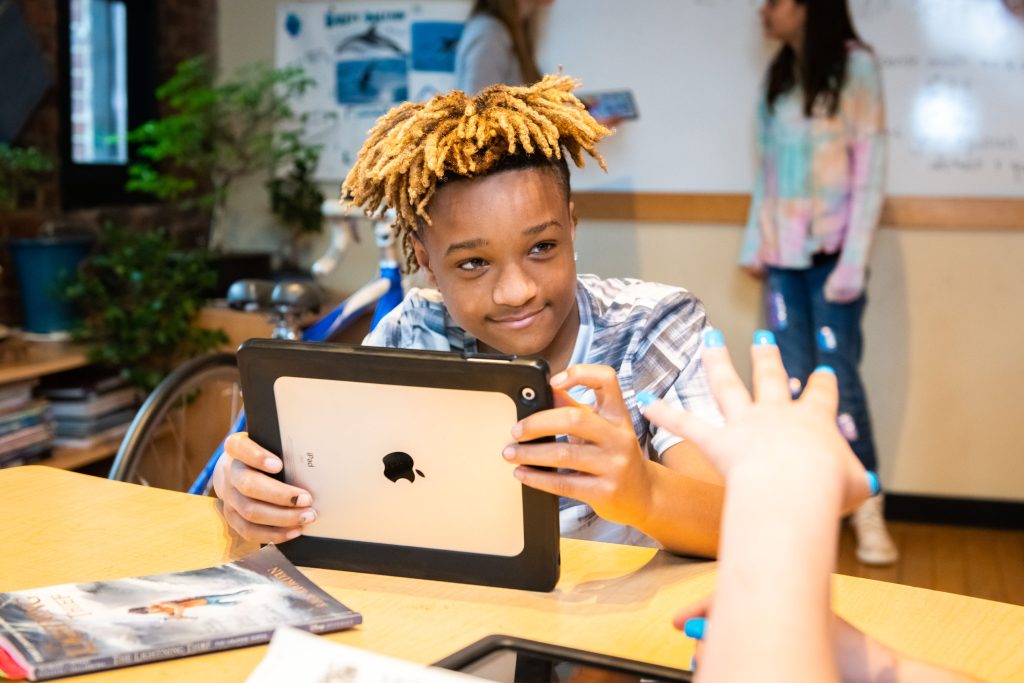
Students apply their developing knowledge through original research, creative production, entrepreneurship, community-centered projects, internships, mentoring relationships, public presentations, and work connected to authentic needs beyond the classroom.
They do not simply demonstrate that they have learned something. They use what they have learned to make, solve, explain, improve, question, and contribute.
A Four-Year Journey Toward Independence
High school should unfold with intention.
Each year at Voyagers’ builds not only greater academic knowledge, but greater independence, responsibility, self-awareness, and engagement with the world.
Grade 9 — Thinking
How do I understand myself, others, and the world?
Students establish the intellectual and personal foundations of high school through reading, writing, mathematical reasoning, scientific inquiry, discussion, research, reflection, and close observation.
They learn to ask stronger questions, distinguish evidence from assumption, communicate their thinking, consider multiple perspectives, and become more aware of how they learn.
The first year is not about determining a permanent path. It is about widening the field of possibility and building the habits needed to explore it thoughtfully.
Grade 10 — Designing
How do I create solutions that matter?
Students begin turning ideas into action. They investigate systems, identify authentic problems, conduct research, collaborate across disciplines, design possible responses, build prototypes, test assumptions, receive feedback, and revise their work.
Designing teaches students that worthwhile ideas rarely arrive fully formed. Meaningful work develops through curiosity, patience, experimentation, persistence, and the humility to improve what has already been created.
Grade 11 — Launching
How do I bring value into the world?
Students increasingly extend their work beyond school through internships, entrepreneurship, mentorship, college coursework, professional experiences, community partnerships, and more ambitious independent projects.
They learn how to approach adults professionally, communicate an idea, meet expectations, respond to feedback, manage time, solve unforeseen problems, and contribute to work larger than themselves.
Launching does not require every student to start a business. It develops an entrepreneurial mindset: the ability to recognize opportunity, take initiative, create value, adapt to change, and move an idea forward rather than waiting for someone else to provide the next step.
Grade 12 — Growing
How do I build a meaningful life and contribute to the world?
The senior year brings together intellectual study, authentic experience, reflection, leadership, and future planning.
Students deepen their work through advanced internships, college courses, leadership, capstone projects, professional relationships, entrepreneurship, creative production, or sustained investigation in an area of genuine importance to them.
The final year is not simply about completing high school.
It is about leaving with a clearer understanding of personal strengths, values, responsibilities, and possibilities—and with credible evidence that the student is ready to take the next step.
This four-year progression—Thinking, Designing, Launching, and Growing—reflects the model we developed for students to move from intellectual foundations toward purposeful, increasingly independent work.
A Rhythm That Connects Study and Experience
Students need both focused intellectual study and opportunities to apply what they know.
Mornings at Voyagers’ are generally devoted to the foundations of an educated adult life: Humanities which incorporates reading, writing, and history, mathematics, science, research, discussion, communication, and critical thinking.
Afternoons open into application.
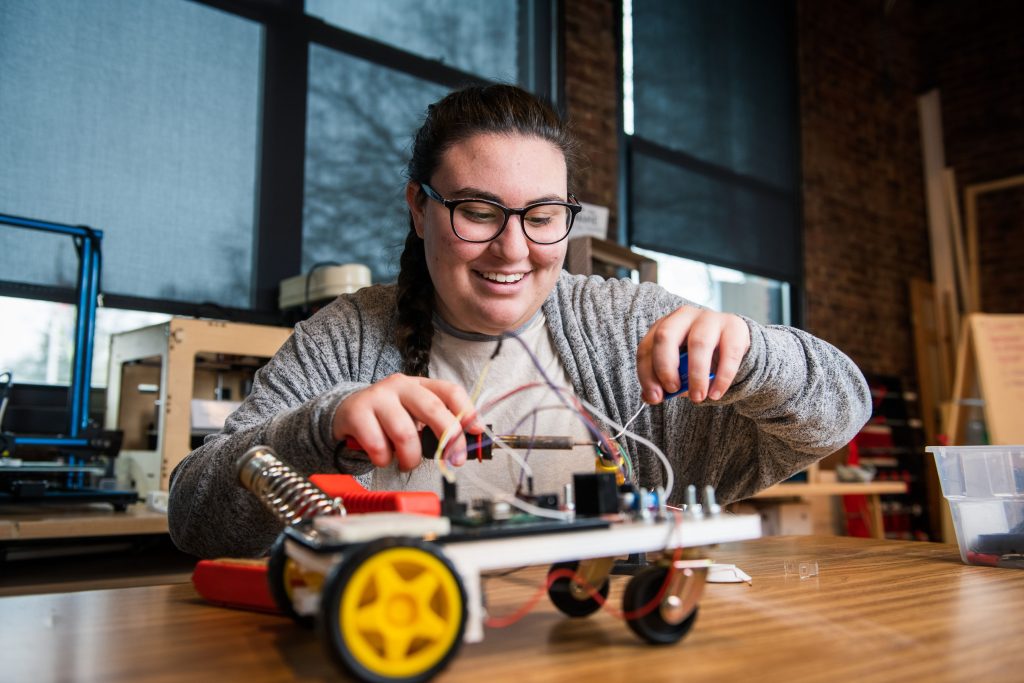
Students may develop a venture, work with a mentor, pursue an internship, build or design something, contribute to a community project, explore a trade, create original work, investigate a problem, or develop a sustained project from conception through completion.
This rhythm allows students to experience academics not as isolated subjects, but as indispensable tools.
- Writing matters because ideas must be communicated.
- Mathematics matters because decisions require analysis.
- Science matters because the world must be investigated with evidence.
- History and literature matter because thoughtful people need to understand human experience, perspective, power, culture, and consequence.
- Reflection matters because experience alone does not guarantee learning.
The goal is not to divide school into “academic” and “real-world” learning. It is to help students recognize that the two belong together.
Prepared for a World in Motion
The world our students are entering will continue to change—technologically, economically, socially, and environmentally.
Young adults will need more than a fixed body of knowledge. They will need the ability to learn continuously, evaluate information, use emerging tools wisely, communicate across differences, collaborate with others, navigate uncertainty, and respond creatively when familiar solutions no longer work.
At Voyagers’, students develop these capacities through practice.
They work in teams and independently. They encounter disagreement. They explain their reasoning. They manage projects that do not always unfold as planned. They use technology and artificial intelligence as tools for inquiry, analysis, creation, organization, and problem-solving while learning to question their limitations, biases, and ethical implications.
AI fluency is not treated as the ability to generate faster answers.
It is the ability to ask better questions, assess the credibility of an output, preserve independent thought, use tools responsibly, and decide when human judgment, imagination, empathy, and discernment matter most.
Students become more future-ready not by predicting exactly what the future will hold, but by becoming nimble, resourceful learners who know how to adapt without losing sight of their values.
The Voyager Profile
A Comprehensive Record of Learning, Achievement & Readiness
Every Voyagers’ graduate receives a traditional transcript documenting courses, credits, and academic performance.
But a transcript cannot tell the whole story.
The Voyager Profile captures the fuller arc of a student’s high school experience: intellectual development, original work, professional experience, college coursework, leadership, collaboration, entrepreneurship, creative accomplishments, community contribution, and growth over time.
It may include:
- significant projects and original research
- internships and professional experiences
- college and dual-enrollment coursework
- entrepreneurial or community ventures
- exhibitions, presentations, and public work
- creative and technical accomplishments
- leadership and service
- teacher observations and narrative assessments
- student reflection and evidence of developing competencies
The Voyager Profile does not replace the transcript. It makes the student visible beyond it.
It offers colleges, employers, mentors, families, and students themselves a richer understanding of what the graduate has studied, created, attempted, contributed, and learned to do.
Most importantly, it documents not merely what a student completed, but the thoughtful, capable young person emerging through the work.
College, Career & Future Planning
Every student’s path after high school is different, but every student deserves thoughtful guidance.
Some Voyagers’ graduates pursue four-year colleges or universities. Others may begin at a community college, enter a specialized or technical program, continue working within an established profession, build a business, pursue creative work, or combine several pathways over time.
Our responsibility is not to steer every student toward the same destination. It is to help each student make an informed, ambitious, and realistic decision about what comes next.
Planning is personal and begins well before senior year. Students explore interests, examine possible fields, build relationships with adults doing meaningful work, investigate college and career options, develop application materials, consider financial realities, and reflect honestly on the environments in which they are most likely to flourish.
Our location on the Brookdale Community College campus creates unique opportunities for students to earn college credits while still in high school. As they begin their college journey, students receive the guidance and individualized support of their Voyagers’ Teacher/Researchers, helping them build confidence while successfully navigating college-level expectations.
Since Voyagers’ first graduating class, every senior seeking admission to a four-year college has been accepted to one or more institutions.
We value that record. But we measure success by more than where students are accepted.
We look at whether they understand why they are choosing a path, whether they are prepared to meet its demands, and whether they have the confidence and adaptability to change direction as they continue to grow.
Independence Grows Through Relationship
Teenagers need room to make decisions, encounter consequences, test ideas, experience uncertainty, and develop a stronger sense of self. They also need thoughtful adults.
At Voyagers’, independence does not mean leaving students to navigate high school alone. It develops through a gradual transfer of responsibility within trusted relationships.
Teacher/Researchers serve as mentors, intellectual partners, observers, challengers, and guides. They pay close attention to what students understand, what they avoid, what excites them, where they need greater challenge, and when they are ready for increased independence.
Students learn to advocate for themselves, manage commitments, ask for help, navigate conflict, collaborate across differences, give and receive feedback, and contribute to the life of the community.
These capacities cannot be taught effectively through a worksheet.
They grow through relationships and repeated experience.
The aim is not dependence on adults, nor premature independence from them. It is the development of judgment—the ability to know when to proceed independently, when to seek counsel, how to evaluate advice, and how to accept responsibility for one’s decisions.
Who Thrives at Voyagers’ High School?
Voyagers’ may be a strong fit for students who:
- think deeply, creatively, or differently
- want greater meaning and connection in their education
- benefit from being known well by their teachers
- value discussion, inquiry, and authentic relationships
- are ready to grow in independence and responsibility
- want opportunities to create, contribute, and engage with the world
- seek intellectual challenge without a culture built around comparison
- need a smaller, more responsive environment
- are willing to participate actively in shaping their learning and community
Voyagers’ does not attempt to reproduce a conventional high school on a smaller scale.
Our students are expected to engage, reflect, collaborate, take intellectual risks, meet meaningful expectations, and gradually assume greater responsibility for their work and choices.
This is a deeply supportive environment. It is not a passive one.
Sometimes Families Wonder…
Will my child receive a serious and intellectually challenging education?
Yes. Intellectual depth at Voyagers’ grows through sustained reading, writing, mathematics, scientific thinking, research, seminar discussion, interdisciplinary inquiry, and work requiring students to analyze, create, defend, revise, and communicate.
Will my child be prepared for college?
Students receive recognized transcripts, individualized college and career guidance, opportunities for college coursework, and support through the application and transition process. Preparation is both academic and personal: students learn to manage their work, communicate with adults, seek support, meet deadlines, and take responsibility for their choices.
What if my child does not yet know what they want to do?
Most adolescents do not—and they should not be pressured into premature certainty. High school is a time to explore widely, encounter unfamiliar possibilities, test interests, and learn through experience. Direction develops gradually from reflection, exposure, mentorship, and meaningful work.
Is the program only for future entrepreneurs?
No. Entrepreneurship is one important avenue for authentic learning, but our broader goal is an entrepreneurial mindset. Every student benefits from learning how to recognize possibilities, solve problems, take initiative, adapt, collaborate, and create value in whatever field they pursue.
Will my child be sufficiently supported?
Support begins with relationship. Because Voyagers’ is intentionally small, educators know students closely and can respond thoughtfully to their development. Support does not eliminate challenge; it helps students engage with challenge productively and become more capable over time.
More Than Preparation
High school is often described as preparation for what comes next. We believe these years matter in their own right.
Adolescence is a time to encounter consequential ideas, build trusted relationships, experience genuine accomplishment, recover from mistakes, discover unexpected strengths, and begin contributing to a world beyond oneself.
Students should not spend four years merely rehearsing for life. They should be invited to participate in it—with guidance, mentorship, intellectual challenge, authentic experience, and increasing responsibility.
By graduation, we want students to leave with more than credits.
We want them to carry forward the confidence to enter unfamiliar situations, the judgment to think for themselves, the empathy to work well with others, the resilience to adapt, the initiative to create opportunity, and the desire to make a meaningful contribution.
Experience Voyagers’ High School
The best way to understand Voyagers’ is to spend time within the community.
Meet the Teacher/Researchers. Ask questions. Learn how academic studies, mentorship, authentic work, and individualized planning come together. Explore whether Voyagers’ feels like the place where your teenager might grow in confidence, intellectual depth, direction, and purpose.
The world needs more than graduates. It needs thoughtful, capable, compassionate people. At Voyagers’ High School, young people discover who they are by doing work that matters.